Overview
ParallelStencil empowers domain scientists to write architecture-agnostic high-level code for parallel high-performance stencil computations on GPUs and CPUs. Performance similar to CUDA C / HIP can be achieved, which is typically a large improvement over the performance reached when using only CUDA.jl or AMDGPU.jl GPU Array programming. For example, a 2-D shallow ice solver presented at JuliaCon 2020 [4] achieved a nearly 20 times better performance than a corresponding GPU Array programming implementation; in absolute terms, it reached 70% of the theoretical upper performance bound of the used Nvidia P100 GPU, as defined by the effective throughput metric, T_eff (note that T_eff is very different from common throughput metrics, see Performance metric). The GPU performance of the solver is reported in green, the CPU performance in blue: 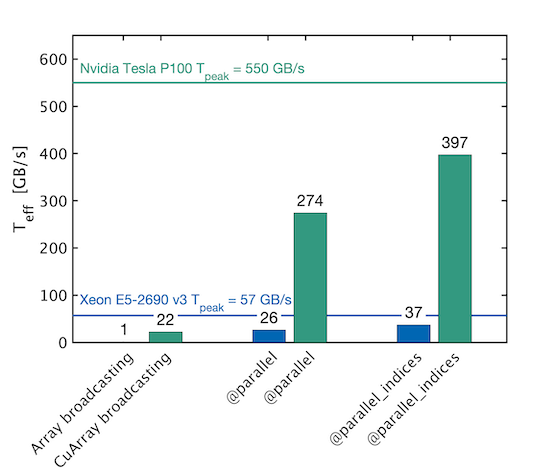
ParallelStencil relies on the native kernel programming capabilities of CUDA.jl, AMDGPU.jl, Metal.jl, the multi-architecture KernelAbstractions.jl package (enabling runtime hardware selection), and on Polyester.jl and Base.Threads for high-performance computations on GPUs and CPUs, respectively. It is seamlessly interoperable with ImplicitGlobalGrid.jl, which renders the distributed parallelization of stencil-based GPU and CPU applications on a regular staggered grid almost trivial and enables close to ideal weak scaling of real-world applications on thousands of GPUs [4–7]. Moreover, ParallelStencil enables hiding communication behind computation with a simple macro call and without any particular restrictions on the package used for communication. ParallelStencil has been designed in conjunction with ImplicitGlobalGrid.jl for simplest possible usage by domain-scientists, rendering fast and interactive development of massively scalable high performance multi-GPU applications readily accessible to them. Furthermore, we have developed a self-contained approach for "Solving Nonlinear Multi-Physics on GPU Supercomputers with Julia" relying on ParallelStencil and ImplicitGlobalGrid.jl [4]. ParallelStencil's feature to hide communication behind computation was showcased when a close to ideal weak scaling was demonstrated for a 3-D poro-hydro-mechanical real-world application on up to 1024 GPUs on the Piz Daint Supercomputer [4]: 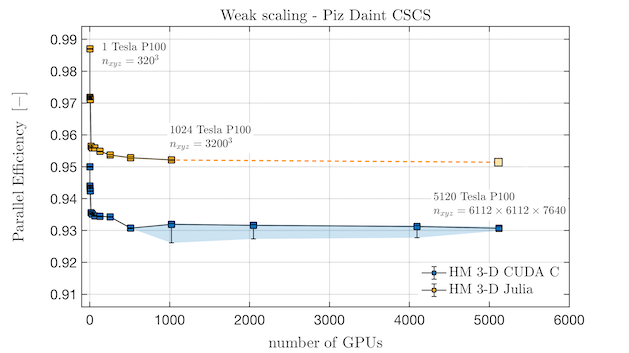
A particularity of ParallelStencil is that it enables writing a single high-level Julia code that can be deployed both on a CPU or a GPU. In conjunction with ImplicitGlobalGrid.jl the same Julia code can even run on a single CPU thread or on thousands of GPUs/CPUs (see the 50-lines multi-xPU example).
Beyond traditional high-performance computing, ParallelStencil supports automatic differentiation of architecture-agnostic parallel kernels relying on Enzyme.jl, enabling both high-level and generic syntax for maximal flexibility.